
Simplifying the board and adjusting some of the Actions cards made a huge difference. The playthrough of version 5 went really well. No changes required by the end of the game, but more testing is required.

I exist!
...In Boardgamegeek that is. My name, publishing name and IMDL! have been approved. It's a little step on a long road but I kind of feel validated now, seeing that 'Game Designer' stamp underneath my name. It's the small things...
Now I've got figure out how to get my logo and gaming pictures on there.
In other news, replacement parts have been sent. Hopefully 2 weeks away and I'll be able to do a full test.
No Cones
Ack. Waited 3 weeks for a job lot of cones to test 'Stalagmites'. The bag arrives and it contains 200 'Connect 4' pieces.

Guess I'll be waiting another 3 weeks...
The Color of Light - Versions 3 & 4
It's great to have opportunities to test prototypes. I'm part of a very forgiving gameing group that gives my latest effort a go.

I've managed to make some changes after Thursday's playtest, and give it another on Sunday at a Board game convention in Wellington. (It's Your Move). Improvements were made and the feedback was good.

However, I think the 'tree' gimmick is going to have to go. Although I love the idea of reaching inside 'the tree stump' for the orbs, ultimately it was blocking the board. For some reason, I had this edict in my head that I couldn't have two bags in a game (the other is for the dice.)
The good thing about play-testing with gamers is that they can then give you a long list of successful games with two or more bags, so I'm going to throw that rule out of the window and try it. Maybe a nice brown leather bag in the centre...
The Color of Light (was Dawn...) - First Playthroughs
I haven't managed to test one of my games on account due to having to wait for a job-lot of dice to show up from China (6 weeks!). Thankfully, Shem stepped up and let me borrow some of his library to test over the weekend.
The Color of Light, (was ..of Dawn) came together really well. Only managed to play it with 2 players, but it played well out of the gate. On to version 3 now but it's just tweaks rather than wholesale changes, which is encouraging. I'll post more details about the game once it's got a few more playtests under its belt.
I've got some small Wellington conventions coming up over the next couple of weeks. I'll be taking along my efforts to test on the masses. Fingers crossed. Now, back to the guillotine...

I have an artist!
...And he's homegrown which is awesome. I joined the New Zealand Comics Facebook group a while back. Eddie's art popped up on my feed the other day. I really liked his clean line style, it reminded me of Michael Avon Oeming's work, especially the 'Powers' comic.

Standing in front of the firehose

Shem managed to pick one of these Panda packs for from his trip to GenCon last month. Handy, it gives some sample of what the Game Manufacturing company can produce.
I downloaded their Design Guidebook from their website a couple of days ago. Extremely informative and very helpful on how to do things, and not to do things. I won't lie, it was also 'slightly' overwhelming.
I think one of the biggest takeaways is that the software I've been using for my game design (Visio and Publisher) simply isn't going to cut it. So I'm going to have to research and possibly invest money and time in learning more suitable software.
On trying to be subjective
I was talking to Clare last night about how the playtesting went at the weekend. I mentioned that the 'Road Crew' could have gone better, and that it got a bit chaotic as the game went on.
Concerned, she asked me, how I felt about it, and if I was upset. I answered honestly, no. After all, the idea of a play-test is exactly that. I'm sure most designers would like a perfect play-though first time but it's not going to happen. It's the old adage that 'No Plan Survives Contact with the Enemy'. What seems like a working idea in your head may be an absolute mess when another three brains get added to the mix.
Regardless of how well it went, I've got into the habit of asking, is there a seed of a good idea there? There's no point flogging a dead horse if the principle idea is bad. But if players can gleam a nugget beneath the detritus of unnecessary rules and tokens, then it's worth working on.
Sure, thick skin may be needed. I know twenty years ago, I would have taken the criticism to heart, but the point is, if we're trying to make the best game possible, regardless if it's a little 20 minutes time filler, or a three hour epic, then any feedback is good feedback. Mostly.
IMDL! - What's next?
EXPANSIONS! A word that fills me with excitement, and my wife with horror. There's plenty of room for more content beyond the base game. Actually, I'd like to create another enemy set for the standard edition, just to give the players more choice. Currently, there's Aliens, but I've got scope for Dark Ones (Cthulhu-esque monsters), Kaiju (Godzilla etc.) and Rogue Nation (SPECTRE).
What else?
More Warriors with different skills. - Expanding to 2 a region.
More Mods
More associated Dice abilities
Different mech tableau with different load-outs. (3 arms, 4 legs etc.)
Team play
It's got scope. Lots of scope. First things first though. Let's get the base built!
Eggs in a basket
So I've got several other games I'm working on at the moment. Different types of games from IMDL! One of the things I've heard is that if you're serious about game design, you should try a diversify, so my other efforts have been vastly different, which has been a nice change. Smaller to design, less pieces to create, and quicker to play.
I've went to another design workshop at the weekend. As I've said in the Design blog, they are invaluable for feedback. I tested a couple; The Road Crew which is a light 'take that' game based around roadies at a festival, and an abstract game called Stalagmites.
I've got a tendency to gold plate my prototypes, which one could argue, could be a monumental waste of time, especially if they're rubbish. I didn't do that with Stalagmites. It played well, better than I thought, so now I feel justified buying some game pieces for it.
Seriously, if I won the lottery, I think I'd set up an Australasian center for game parts. They take a bloody age to get here. I've been waiting over 4 weeks for counters and dice to arrive for another game I'm working on.
Back to drawing board...
Version 10.1
Major tweaking territory now...
I took this version to another Game Design workshop.
THE MAIN BOARD

I added some more spaces to the Threat Level.
I tweaked the Skill Upgrades and the Minimum VP benchmarks on the Victory Point track after a couple of plays.
VERSION 10.1: THINGS I LEARNT
It's there. Games have been running smooth. A couple of suggestions here and there, but the game is working, and it's fun. (Which is the point after all!)
Designing myself into a corner - Part 2
If I want to self publish the game, I'm going to source these dice from somewhere. The obvious choices are to go to the companies that produce their own.
I contacted Libellud within the last couple of weeks. They've said straight away that they're not available for third parties. Bummed as they're a beautiful design.
Rio Grande have been taken my shopping list of required bits including face artwork, but they've yet to get back to me. That was before GenCon.
So there are 3 avenues open at this point:
Source from the supplier - looking less likely by the day.
Make my own - where to begin with this, I have no idea.
Change the game design to use another mechanic - This is possible but goes against the point of the game.
It's difficult choice. There seems little point working the rest of it until I know I can get the dice. I'll give it another week. Finger's crossed...
Version 10
The biggest change with this version was taking on board Paul's comments regarding the mech warriors. I didn't want to lose them, but the question was how to make their roles bigger.
This is how I did it...
MECH WARRIOR PLATES

I've separated the warrior from the mech tableau and combined them with the Power/Speed meter.
I've given each warrior 3 personality traits.
This in turn, has defined a list of unique predetermined skills available to them. Up to this point, skills were randomly picked from a stack. Instead, I've tailored the skills to each warrior, matching their traits.
As before, these skills get unlocked when the player manages to gain enough VP's.
The skill cost relates to a new mechanic, which is using the defeated enemy cards as currency. Until now, they were just used as tie breaker deciders. Now, they can be used to activate skills, and also another resource to be bartered between players.
Lastly, Shem noticed that the ability to alter speed independently of the power never got used by players. If it's never used, chuck it out. The speed has now been fixed to the power. Also, it drops as the mech takes damage which means the mech becomes slower, thematically making sense.
RESOURCES
Resources are now fixed and linked to the enemy's power. So players earn between 1-3 resources for defeating an enemy. This now means players know exactly want they're fighting for before the engagement begins. Bartering between players becomes clearer too.
THE MAIN BOARD
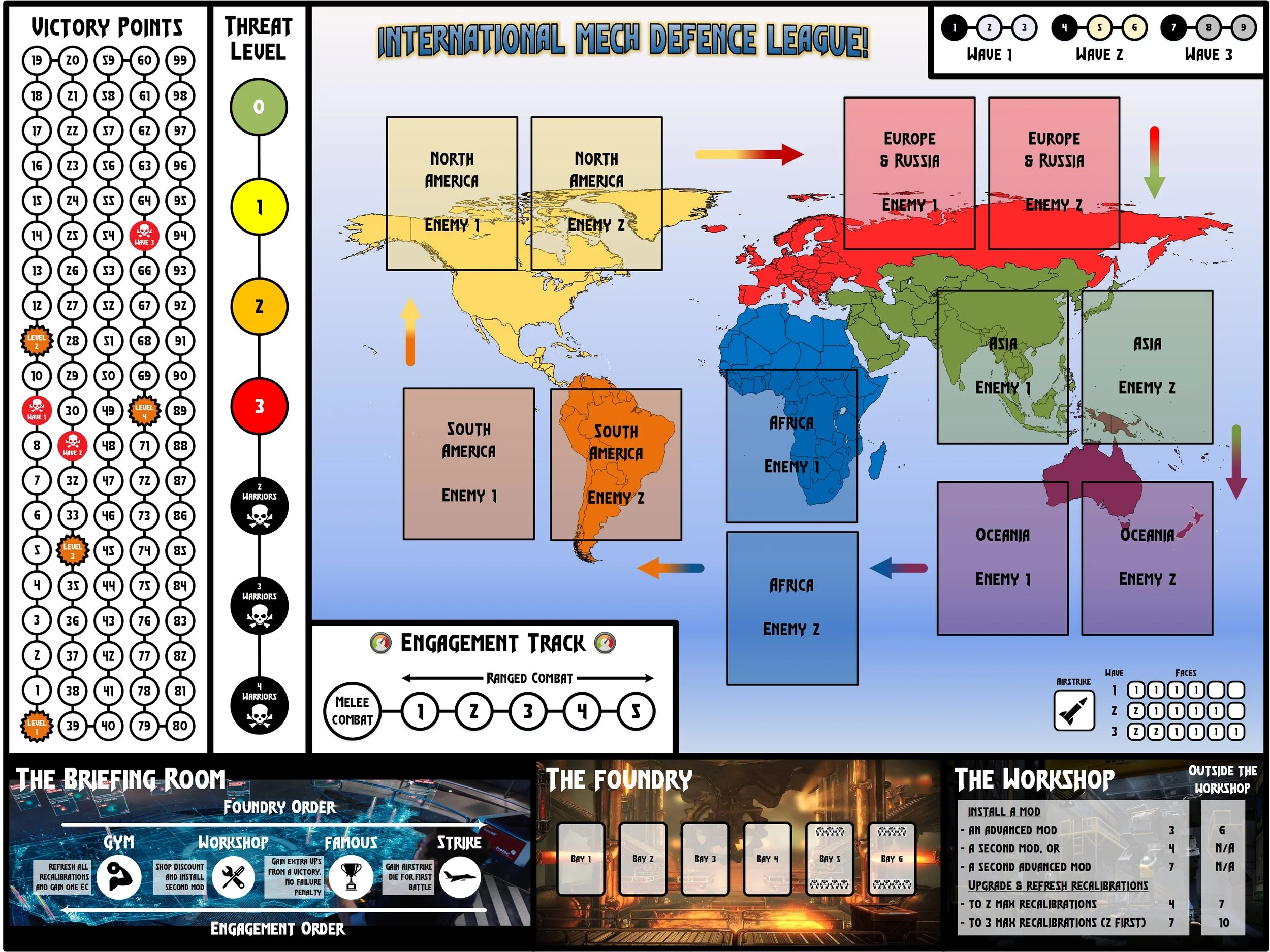
VP targets have been added to the VP tracker. Players now have to reach these targets before the end of the wave otherwise the Threat Level will increase (with each unsuccessful player not making it.)
The Workshop values have been altered to bring them in line with the changes made to the mech warriors and fixed resources.
Sidekick has been replaced with 'Airstrike' as it makes more thematic sense. This has also been altered in the Briefing Room. ('Strike')
The Gym Perk introduces the 'Gym Card'. These act like dummy enemy cards, allowing players to use them for skills.

VERSION 10: WHAT I LEARNT
Minor tweak territory now. However, if one part is changed, it's bounces onto all other aspects of the game.
One part I didn't change which I should have done was the Threat Track. Now, with more ways to generate threat in the game, the scale was too small and became very difficult for the players to win. Doh!
Version 9
I finally made the leap to reduce the number of rounds. This had a knock effect to game balancing, and the components.
I took this version to the next Design Workshop in Wellington...
THE MAIN BOARD

The new wave number was now reflected on the board.
Due to the number of reduced rounds, I had to adjust the resource costs for upgrades in the Workshop.
I reduced the number of steps on the Threat track as well.
In the last version, I added an area for multiple players to 'lock' their dice, but it didn't really work. A friend of mine (Thanks Luke!) suggested I moved the 'lock' function onto the enemy cards, which i did, but that in turn increased the size of the cards slightly. So I had to move some bits around on the board.
ENEMY CARDS

With less rounds, I had to reduce the number of enemy cards.
As stated above, I put 'lock' templates around the damage icons so they could be covered by the players' dice during an engagement.
I also slimmed down the Shield and Health tracks.
MECH TABLEAU

I hadn't really messed with the Tableau layout, other than adding the recalibiration functions. However, due to dropping the rounds, I needed to reduce to the number of slots. I never really felt comfortable with the 'Wings' and foot 'Boost' spaces. They were in pairs and it looked odd just adding one at a time. So the no brainer was to get rid of them and add a single 'Core' slot.
MECH MODS

Because of the reduction of mod slots, I had to revamp all the mech mods peices. Again.
I also reduced the number of mods down to 108.
I added a red border around the advanced mods to make them easier to see.
VERSION 9: THINGS I LEARNT
Again, the design workshop players were fantastic. Paul Tobin from Weta Studios (Also working on a big mech game! - GKR: Heavy Hitters) gave me some great pointers on making improvements.
The big takeaway was the mech warriors themselves. Up until now, they were lonely portraits stuck at the top of the mech tableau, serving real no function other than adding a little flavor. Paul suggested either expand on them and make them a bigger part of the game, or remove them entirely and let the players 'be' the mech warriors.
The Threat track didn't bother the players too much during the game. He recommended finding other ways to incorporate it into play.
Making the resources claimed from defeated enemies static. That way, players could bargain better with each other on what they knew.
Although the Sidekick die was fun, it wasn't thematically correct. After all, sidekicks don't tend to swap between heroes.
Version 8
'Kill your darlings' is an expression generally used for writers, but it also applies to game design. (I guess it could apply to any type of artistic endeavor.) That's what I did for this version; that is to question every part of the game and ask 'why do I need it?', or 'can I make it simpler'. Here's the results...
THE MAIN BOARD

Major Change 1 - Reduction in the number of areas
Players had more fun when there was interaction. Interaction was forced when the battles were difficult as they needed to work together. Battles were difficult when they were multiple enemies to attack in the same area. This event rarely happened with 20 seeding areas in the previous version. So I reduced the number of regions to 6.
As there was more chance of an 'overflow' occurring, I added arrows to push the extra enemies into the next region.
I increased the number of player regions to six too. America was now split into North and South, Oceania became a separate region. (I had to knock up two more mech templates)
All this meant I had to create specialized seeding, or 'Invasion' dice.

Major Change 2 - The simplification of gaining mech mods
Previously, players received a number of resources at the start of each round which they spend on mech mods. This, on retrospect, was 'ass about face'. If the players were indeed protecting the planet from external forces, why would they need to buy upgrades? And where's the resources coming from in the first place?
So, I did a change where most mech upgrades were free. However, some required extra resources. And these resourced were now earned by killing enemies.
The Workshop became the Foundry, and was simplified. Gone was the two round revolving shelf. 6 mods (4 in a two player game) were placed on the board. Any left over at the end of the round were removed and a new set was added.
Major Change 3 - Introduction of the 'Workshop'
The Workshop morphed into a different way for players to upgrade their mech using collected resources. Discounts were available if they chose the reconfigured 'Workshop' perk.
I reduced the number of recalibrations each player had access to down to 1. Now players had to upgrade their mechs during the game to gain more.
Major Change 4 - Removal of the Shield and Health tracks off the board.
Trying to keep track of multiple enemies on one track was problematic. So I shifted the tracks on to the Enemy cards (see below). Only the Engagement Track stayed on the main board.
Major Change 5 - Simplification of the Threat Track
Trying to manage the separate damage bonuses was a pain and was mostly forgotten about. Also, it wasn't required, the several tweaks to the enemy cards made them tough enough.
Also, the track now never decreased, only climbed, a la Pandemic, creating more tension.
Major Change 6 - Extra skills earned by leveling.
Instead of arbitrarily giving players extra skills at the start of each wave, now they got them by reaching markers on the Victory Point line, adding a sense of achievement.
Change 7 - Upgradable Sidekick die
Originally, the die damage was fixed, so it was potent in the first wave, and a bit naff in the third. Now the damage upgraded with each wave. (shown on the board.)
Change 8 - Dropping to 11 rounds
Another effort in reducing the length of the game.
Change 9 - The Gym Perk
The new 'Gym' perk now allowed a player to make more use of their skills, as previously they felt like one shot wonders and were barely used.
ENEMY CARDS
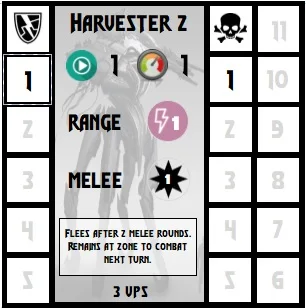
Reducing the number of enemies on the board meant that I could increase the size of the cards, including adding the much needed 'personal' trackers. I designed special markers, which in hindsight, just added another unnecessary asset. I sorted that out in a later version after coming to my senses.
MECH TABLEAU

I added a maximum recalibration marker to the tableau. As the players upgraded their mech, they could place a new counter over the '1' to show their new level.
MECH MODS

Because I removed the resource costs from the cards, I could expand the icons, which made them a lot clearer.
'Advanced' mods, i.e. those that required resources, were given a patterned background. I made around 30 to 35% of the total number, advanced mods.
RESOURCE DICE
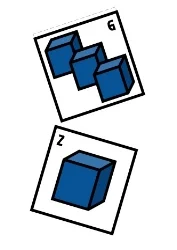
I created another set of specialized D6s that players rolled after defeating an enemy to determine the amount of resources earned.
VERSION 8: WHAT I LEARNED
It played so much better. Taking the constructive criticism onboard and learning from it made for a better game.
We were getting through full games now, but it was still taking too long.
De-powered the 'Fusion' attack power. Far too gross, even for a top tier ability.
Stumbling in the Dark...
Okay, so what do I need to set up a publishing machine?
An awesome name.
A cool logo and some willing artist to design it for me.
A limited company using my awesome name.
A website.
That's a start. I already had the name in mind. The Motherlode had a nice double meaning, and it was the name me and a few of my friends used in our other creative enterprises. Never with 'Games' slapped at the end of it though.
I also had a logo design, so I scoured Deviant Art for an artist who I liked the look of, and was available. I came across Taylor Schmidt's page. I liked his nice clean style and he did logos which was a bonus.
Just over a week later, he had my idea nailed.
(Incidentally, I asked him if was interested in doing the artwork for IMDL!, but after writing down a 'shopping list' of art required, he said he didn't have the time.)
Version 7
I took this version to my first Board Game Design Workshop in Wellington. I can't tell you how much help it was. Thick skin was required, but the feedback was extremely helpful. I made major changes after this play through.
MAIN BOARD

The one large change, recommended to me by Shem* after our Thursday night session, was to use the Perks to determine play order. In reverse VP position, players would choose a perk, and that would govern the order of gaining resources (shown by the Build Order arrow), and who would go on the battlefield first (Engagement Order arrow). There was an advantage to fighting first as the player gets to cherry pick the revealed enemy and there's a good chance there'll get to fight twice which means more VPs for them.
The Perks area of the board was expanded to add more detail.
Also, the Sidekick damage now became a Sidekick die. A separate component that would be rolled along side the players own battle dice. After all, the game is all about rolling dice!
To make way for the Perks, I moved the Threat Line over to the right of the board.
POWER/SPEED DIAL

I 'funked' up the design as the amount of power that the players could obtain was reduced. (due to dropping the number of rounds being played)
I placed a marker on the starting Power and Speed for ease of reference.
OTHER STUFF
I removed the 'Rebound' defense ability on the die from the last game. It was overpowered and almost broke the game, especially having access to the recalibrate tokens to shift the dice faces.
Every Enemy now had some kind of ability. Some synergised with other enemies that on the board.
VERSION 7: WHAT I LEARNED
Richard Durham was one of the playtesters, and was awesomely brutal in his summation at the end. He pinpointed everything he liked about the game, i.e. the dice and mech building, and the dice rolling. And then he circled the rest, basically saying it was getting in the way on him enjoying the good bits.
He highlighted - too many assets, too many things to manage and too many steps. For instance, I had 5 levels of resources that changed over the 3 waves. "Why?", he asked me. "Because the colors are cool", I said. NOT a good enough reason. I was making it more complicated than it needed to be.
And everyone around the table agreed.
Get the rubbish stuff out of the way to get to the good bits.
*Special shout out to Shem Philips (Garphill Games), creator of the awesome 'Raiders of the North Sea'. He play-tested IMDL! twice in as many weeks at this point, and a number of time afterwards. He's always been a massive help during the design process. Check out his games! (http://garphill.com/)
Choices...
So about a month ago, I found myself at a crossroads. As far as I could see it (and I may be wrong in this assumption), I had 2 options:
Rest on my laurels until next year, make my way to one of the events that Rio Grande (or Asmodee/Libellud) attend, and then go on the charm offensive.
Try and publish this beast myself.
As I'm horribly impatient, option 1 was tough to stomach. Option 2 seemed to be an insurmountable task.
However, the idea of building something for myself was an extremely appealing idea (even if it was daunting). And really, there was nothing to lose in at least trying.
So, the first big question was, where does one start?
Version 6
For me, this is where IMDL! started to take shape. I took this version round to my regular Thursday night gaming group. Normally, it's reserved for published games, but the fellas did me the service of playing it through. It was also the first time I played it with 4 players.
The Main Board
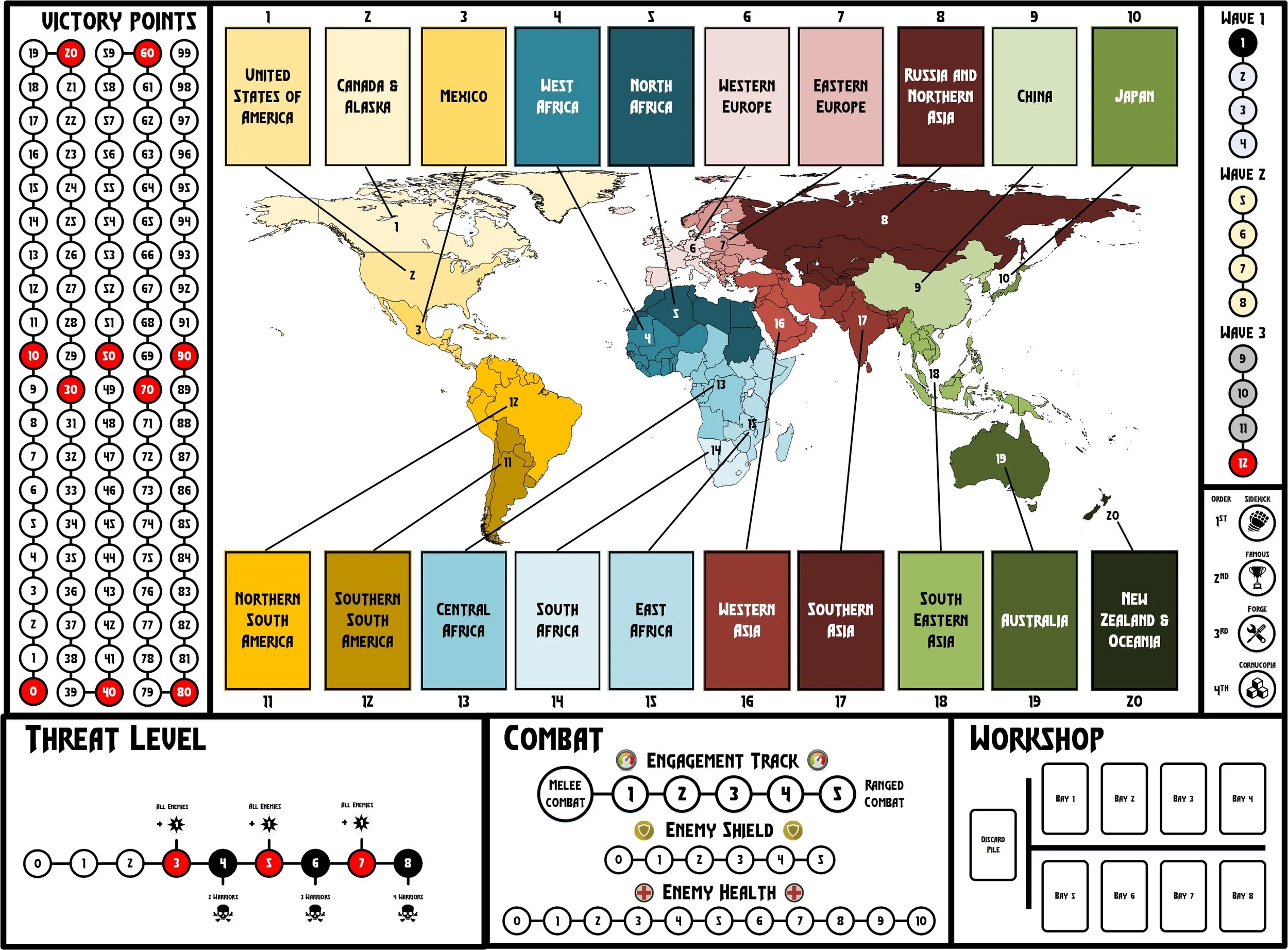
In an effort to shorten the game, I reduced the number of rounds down to 12. (Again, this wasn't enough, but i was at least heading in the right direction.)
I moved the Enemy Cards off the map into their own plates and reduced the number of areas in each region down to 5. That way, only a d20 was required to decide where the enemy would land.
I expanded the number of perks to 4, adding 'Sidekick', which gave a player an extra damage bonus when fighting that turn.
I reduced the amount of bonus damage enemies got when the threat level went up. I would also note at this time, the level would go down if the enemies were removed from the map.
Changed the Shield and Health tracks around as it was less confusing
ENEMY CARDS

I thinned the cards to fit to the board but gave them spaces for shield and health damage trackers in case they stayed on the board. As the number of rounds dropped, I also reduced the number or cards required.
VERSION 6 : THINGS I LEARNT
What really started to become a main factor of the game was the level of interactivity between players. Initially, it was designed to be almost semi-solo, but players had more fun working together and bartering with their dice abilities for resources.
It was still a little confusing the order of play under certain circumstances. This needed to be tidied up.
The threat track wasn't that threatening.
Enemies needed more 'flavour'.
Still too long.
Still too much stuff!
Versions 4-5
The Main Board

In an effort to reduce the amount of stuff, I got rid of the separate workshop and combat board, and put them on the main board. I managed to make room as I removed of the card placement for the threat level track and went with a counter track.
2 main additions were:
Enemy Health and Shield tracker so now we can track damage in combat
Perks (Just above the threat level) - Each turn, a player can chose a bonus. Extra resources, first pick of the mods (usually it was decided by VP position) or first out onto the battlefield. I only had three at the point. Being forth meant you got nothing. (Harsh)
RESOURCE DICE

Instead of cards to get resources, I used dice instead. Because my game needed more dice. (joke) There were 3 sets of dice per wave.
I add the idea of 'Primary' die (marked with a P) and secondary die. Those players that chose the extra dice perk could roll an extra secondary die from more reousrces.
versions 4-5 : things i learnt
Dice are a lot easier to manage (and produce) than cards.
Although i love the map, placing the enemy cards directly onto it got messy and difficult to track once there was a few on there.
More tracking on the board made the combat easier and adding the perks gave the players more options. But it also extended the time of a game that was already too long. I still hadn't had an entire run through yet.