Versions 1-3

Here we go...

The Main Board
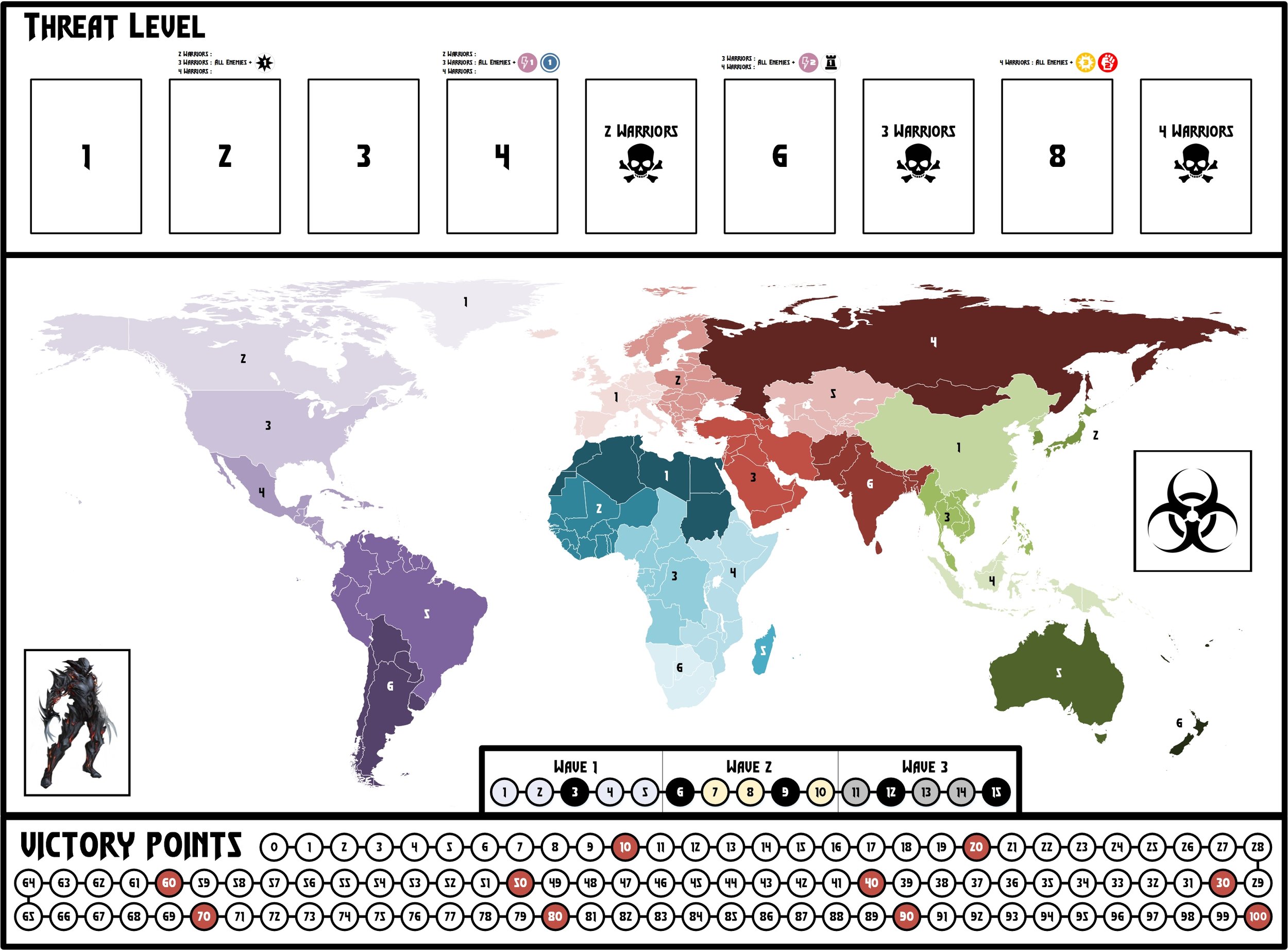
mech map v1.jpg
  • Battles took place on a world map, which was divided into 4 regions (for 4 players), with each region separated into 6 areas. This is where the enemies cards were placed.

  • Turn tracker - Three waves, with five turns each wave. Each wave brought harder enemies but opened up better mech upgrades for the players.

  • Victory Point Line - for recording players' VPs.

  • Threat level line - If enemies were still on the board by the end of the turn, they were placed on the threat track. The more enemies that landed on the track, the more buffs they would get. Depending on the number of players, if the threat level rose too high, the players lost.

The Workshop / Gym board

Workshop v1.jpg
  • This is where the Mech Mod parts were placed. Four at a time. Every turn, they would be shifted down and a new set of mods would be added. The lower set were cycled out after a second round if there were any left.

  • Player skills were placed on the right. Every player started with one skill at the beginning of the game and obtained a new skill at the beginning of waves 2 & 3.

  • The Engagement Track - Players tracked their position to the enemy and which attack dice they'd use. (Range or Melee)

Resource Cards

Resource cards v1.jpg

These cards were drawn at the start of every round by the players. Resources would allow them to buy mods for their mech. There were five different level of resources from common to rare. (white - yellow - blue - purple - red)

Mech Tableau

mech v1-3.jpg

4 warrior Tableaus representing the 4 regions. Each had a starting build and a starting skill. There were spaces to put resources, uninstalled mods, recalibrate tokens (more on that below), and 10 mech part places to enhance their mech.

Mech mods

mech mod v1.jpg

123 separate mods, each showing:

  • which slot they filled

  • Which dice they added to

  • Their abilities

  • their Resource cost

  • Their Power bonus

  • Their cool name!

mech mod upface v1.jpg
  • The reverse of the card showed the weapon art (placeholder here) and the power and abilities.

  • The idea is that the mech template would slowly build with all these call looking weapons and armor, making for a different looking tableau every game.

Power/Speed Dial

power scale v1.jpg

This allowed players to track the power (health) of their mech and adjust the speed (independently). The rule was, speed increased with power but players could forgo an amount of power to increase their speed.

Enemy cards
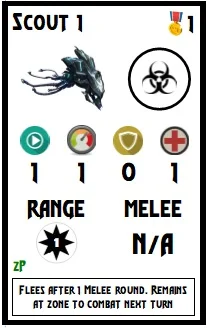
enemy card v1.jpg

4 different types of enemy per wave, up to 25 per wave. They spawned on the board - one enemy per player + 1. In Wave 3, it was ramped to player +2

Each enemy card showed:

  • It's name and level. Each enemy had 3 levels, becoming progressing harder the higher the number, but more Victory Points awarded for defeating it

  • It's Victory Point (VP) reward

  • It's speed

  • Where it started on the Engagement track

  • It's shield and health

  • What damage it did at range and at melee

  • Any special abilities

  • A place to put the marker token if they moved onto the threat track

  • The number of players. (The enemy decks are adjusted to suit)

Dice & powers

20161024_232854.jpg

16 different types. 8 Attack and 8 defense.

Skill Cards

skills v1.png

24 possible skills. Each player was given one at the start of the game based on their warrior, and then an extra one at the start of the each wave. They were dealt two and then kept one.

Counters

  • Engagement Track counter

  • Enemy spawn dice

  • Victory Track player markers

  • Spawn point counters

  • Resource cubes

  • Recalibration Counters

Versions 1-3: What I learnt

  • Dice are random. very random. First time I played the game, i couldn't hit anything because the starting dice were too light. I ended up having to increase the starting builds and adding the Recalibrate mechanic, which gives the player the limited ability to bump the dice to another face.

  • Way too much stuff. As you can see, too many assets, too many parts. There are very few tables that could contain the amount of gear. And because of that...

  • Difficult to track everything. Tokens everywhere but we were still unsure how damage the enemy had taken.

  • Way too long to play. By version 3, I'd managed to play test the game up to round 7. It took 2 hours.

  • Unbalanced. Enemies way too hard.

I had a lot of work to do. However, parts of it were fun. The dice rolling and the mech building were solid. 

However, I needed to do some serious reduction going forward...

The journey begins

In the following posts, I'm going to break down the game by version into it's various parts. As the versions progress, hopefully you'll be able see the evolution in the design.

Reading and listening to other board game designers, the design process should be 'agile'. For those who don't work in IT, it basically means you get a Minimum Viable Product (MVP) out on the table as quick as you can and see what works, building iteratively as you go. That way, little time is wasted on a bad idea, and you can move forward developing the good bits.

I didn't do that.

Quite the opposite in fact. I spent a good few months, designed lots of pieces of cards, and boards, and dice, and...well, you'll see...

Designing myself into a corner and important Lesson #2

As you'll read in the Design Blog, the main component which everything else is built around in IMDL! is the reconfigurable dice. There are not many companies that produce them. Rio Grande (the makers of Rattlebones) and more recently Asmodee/Libellud, who have just released Dice Forge, (very fun game) are the only two I've found. (Not counting the Lego games.) Which means all roads lead to them.

The final event of the year that Rio Grande were attending was Gencon just gone. I found this out about 3 weeks before the event. My very understanding wife said if I needed to go, I should go, but it was the big 50 for GC, and tickets were extremely thin on the ground. Unfortunately it wasn't gong to happen.

So I'm going to have to wait. The next available time will be the middle of next year to have the opportunity to speak to Rio Grande in the flesh.

Which brings me to important lesson number two: Plan ahead. Don't wait until the last minute until you think the game is finished and then expect everybody to queue up to look at it because it isn't going to happen. 

Setting out for Version 1

Rattlebones was good fun, and fortunately, other than the interchangeable dice, had nothing in common with my game. So I put pen to paper. (Or keystrokes to a keyboard.) 

The birth of the idea for IMDL!, which actually hasn't changed through the many versions, was:

  • Enemies invade earth

  • Players take the role of a Mech warrior

  • Players upgrade their mech and corresponding dice

  • Players kick enemy butt.

  • Rinse and repeat against harder enemies with bigger and better mechs.

I knew I wanted an international feel, and I knew wanted to see the mechs grow. How that was going to work took the next couple of months to figure out... 

Things I have learnt #1 (of many)

Board game publishers aren't really interested in seeing you game in an email, no matter how funky your sell sheet looks. Generally, they won't even look at a game unless they can see it with their own eyes in person. And the place to do this is at event/convention they're attending. And you need make an appointment with them beforehand. No wandering up to strangers with pieces of folded card. No sir, that is not a good look.

Here in lies my first, and quite large, problem. I live at the bottom of the world, quite some distance away from most major conventions...

The seed of an idea

20151025_110019.jpg

So, I've had the idea in my head for ages. Birthed from the hours I've spent playing Lego with Max. I loved the idea of building things. Why not incorporate it in a game. This idea coincided with a visit to the Board Game Geek store. Whilst looking for extra game parts, I came across the 'Rattlebones' prototype dice.

I think the dice are designed to be used in a semi-permanent manner, a quick way to knock up some dice to test a game. But my thought was why can't the dice be part of the building mechanism. As you build up your player, it's reflected in the dice.

pic2551066_md.jpg

I needed to see it in action so I brought a copy of Rattlebones to see how the parts worked.

I'm probably being quite naive...

14 months in and I think I've got something. The last playtest at the Wellington Designer's Workshop went well, as had the last two run-throughs prior. The players enjoyed it, I gave them the option to dive out half way but they want to keep playing. A good sign. Minor things were raised at the end, more suggestions than issues but, dare i say it, I've got a playable game on my hands.

I had set myself a goal that if the response was positive at the workshop, I'd take it the next, larger, more monumental step, and see if I could actually get IMDL! published.

This blog is to keep a journal of how, when or if it indeed happens.

A change of focus

I heard Wil Wheaton once say, 'Gaming is the glue that binds friendships together'. It's true. I've been roleplaying as long as I've been board gaming. Having that fortnightly excuse to huddle around the table has always been extremely important to me.

However, as I've got older, priorities have increased almost inversely to the free time I have available. Max arriving was a big part of that. Don't get me wrong, being a Dad is awesome, but with limited windows of opportunity to play, prioritization becomes important.

Board games have become an easier alternative to the longer commitment of a role-playing game. Numbers at the table can be flexible and continuity isn't an issue. Also, board games appeal to more people, so there are more options to play. And I believe there's a board game out there for everyone.

20170429_161853.jpg

Creating my first game. a.k.a. How to make things as difficult for myself as I possible can.

The purpose of this blog is to talk through the design process of my first game, International Mech Defence League! It's been 14 months from original conception to a state where I can say that it plays well.

As a first time designer (at this level at least) I probably went for one of the more complicated types of games. I haven't made it easy for myself, and I've made a ton of mistakes on the way.

But it's a learning process, and a wiser man than me once said, 'a person who's never made a mistake, has never made anything.'

So hopefully, over these next few posts, I can share some of my learnings. (Actually more for me to remember so I don't repeat them.)